
Our Approach and Commitment to Sustainable Development

As a multinational group, Fuburg Group is committed to pursuing steady growth and long-term sustainable development. We place equal importance on business performance, sustainability responsibilities, and our responsibilities as a global corporate citizen. Internally, these principles are integrated into our corporate culture and employee code of conduct. Externally, we continue to develop environmentally friendly products, address social issues, and support community initiatives. Through consistent top-down implementation, we strive to achieve positive outcomes in both sustainable development and business performance, creating lasting momentum for the Group’s continued growth.
Amid changes in the global economy, intense market competition, and fluctuations in the prices of key raw materials, Fuburg operates in an industry that is highly influenced by broader economic conditions. In response to changes in the operating environment and evolving product applications, Fuburg has continued to transform its business in recent years, focusing on product innovation and development, higher-margin products, and enhanced product value. We seek to diversify our product portfolio, strengthen service delivery, increase market share, reduce production costs, improve product quality, enhance profitability, and provide consumers with products at reasonable prices.
In addition to optimizing our product portfolio and improving our profit structure through research and development, Fuburg also plans to establish a cloud-based care and home-delivery CRM service platform to create greater corporate value and strengthen its position in the industry.
At the same time, Fuburg remains committed to sustainability and global corporate citizenship. A cross-functional ESG task force has been established internally to promote sustainability awareness among employees and advance related initiatives in accordance with globally recognized sustainability reporting standards and guidelines.
In terms of social contribution, Fuburg has maintained a long-term partnership with the Fuburg You-Yi Cultural and Educational Foundation, supporting donation programs and care initiatives for disadvantaged groups.
Fuburg firmly believes that sustainability can only be truly implemented when every employee embraces sustainability responsibility. By embedding sustainability into our core values, we aim to achieve sustainable operations, respond to stakeholder expectations, and contribute to a harmonious society and a healthier environment.
Policy Commitments
Guided by its corporate mission of “Integrity and Simplicity, Environmental Protection First, and Care for the Disadvantaged,” Fuburg incorporates ethical business practices, human rights protection, environmental protection, climate governance, and energy management into its key commitments to sustainable development.
Through the respective responsibilities of the Board of Directors, management, and relevant departments, the Company progressively integrates environmental, social, and governance issues into business decision-making, risk management, internal policies, and daily management procedures, thereby fulfilling its responsibilities to shareholders, employees, customers, suppliers, communities, and other stakeholders.
Human Rights and Labor Rights
Fuburg complies with labor laws in the locations where it operates and upholds the principles of human rights protection. The Company values employee dignity, equal employment opportunities, workplace safety, diversity, and inclusion.
Fuburg is committed to preventing unfair treatment based on gender, age, disability, nationality, race, religion, political position, marital status, family caregiving responsibilities, or other factors unrelated to job capabilities, and strives to provide a safe, healthy, respectful, and equitable working environment.
The Company also places importance on employee communication and grievance mechanisms. Through Human Resources, communication with supervisors, internal grievance channels, and relevant management procedures, employees may raise concerns regarding working conditions, workplace interactions, human rights, or labor rights. Matters are reviewed and addressed according to their nature, with necessary improvements implemented to reduce the risks of inappropriate workplace treatment and labor rights violations.
Anti-Corruption and Ethical Business Practices
Fuburg conducts its business with integrity, transparency, compliance, and accountability. The Company is committed to complying with applicable laws and its ethical business principles.
Directors, managers, employees, and individuals acting on behalf of the Company are prohibited from directly or indirectly offering, promising, requesting, or accepting improper benefits, and from engaging in fraud, conflicts of interest, inappropriate entertainment, breaches of fiduciary duty, or other unethical conduct.
Through internal policies, employee codes of conduct, internal controls, audits, and education and awareness programs, Fuburg strengthens employees’ understanding of ethical business practices, regulatory compliance, and professional ethics. Suppliers and business partners are also expected to follow the principles of fair transactions, legal compliance, and ethical cooperation to protect the Company’s reputation and stakeholder interests.
Environmental Protection
Fuburg recognizes that manufacturing operations are closely related to the use of environmental resources. Environmental protection is therefore incorporated into product development, production management, equipment improvement, waste management, and supply chain cooperation.
The Company continues to promote energy conservation and carbon reduction, plastic reduction in product design, the development of products using environmentally friendly materials, efficient resource utilization, and pollution prevention.
Through environmental management systems, operating procedures, employee awareness programs, and on-site management measures, Fuburg works to reduce the environmental impact of its operations.
The Company also continues to address environmental issues such as water resources, energy use, waste management, and air pollution prevention, while progressively improving the completeness of environmental information disclosure based on the Company’s scale, process characteristics, and available data.
Climate Change and Energy Management
Fuburg recognizes climate change as an important sustainability issue affecting operational resilience, supply chain stability, energy costs, product design, and market demand.
The Company is committed to progressively strengthening the identification, assessment, response, and monitoring of climate-related risks and opportunities. Through Board oversight, management leadership, and implementation by relevant departments, climate-related issues are incorporated into daily operations and risk management.
Fuburg continues to promote energy-use monitoring, equipment efficiency improvements, process optimization, greenhouse gas inventories, plastic-reduction product development, and responses to low-carbon market demand.
The Company also evaluates feasible approaches to renewable energy use, supply chain carbon management, and carbon footprint tracking, with the aim of progressively improving energy management efficiency and climate governance capabilities.
Sustainable Supply Chain Management
Fuburg values the performance of its suppliers in environmental protection, labor rights, occupational safety and health, ethical business practices, and product quality.
Through supplier communication, evaluation, review, and cooperation management procedures, the Company requires suppliers to comply with applicable laws and regulations, fulfill environmental and social responsibilities, and progressively incorporate sustainability requirements into supplier management.
For important or high-risk suppliers, Fuburg conducts follow-up and communication based on procurement and supply chain management needs, encouraging supply chain partners to strengthen sustainability awareness and reduce risks related to raw material supply, environmental regulations, labor conditions, and business integrity.
Implementation and Review
Fuburg’s policy commitments apply to the Company’s principal operating activities and internal management practices. Depending on the issue, implementation is jointly carried out by the Board of Directors, management, the General Manager’s Office, Administration Department, Human Resources, Manufacturing, Procurement, Finance, Research and Development, Internal Audit, and other relevant departments.
The Company will continue to disclose its sustainability management practices and implementation progress through its Sustainability Report, corporate website, Market Observation Post System, and stakeholder communication mechanisms.
Based on the principle of materiality and stakeholder concerns, Fuburg will continue to review relevant policies, procedures, and implementation results on a rolling basis to further strengthen its resilience in sustainable business development.
Sustainability Management Committee
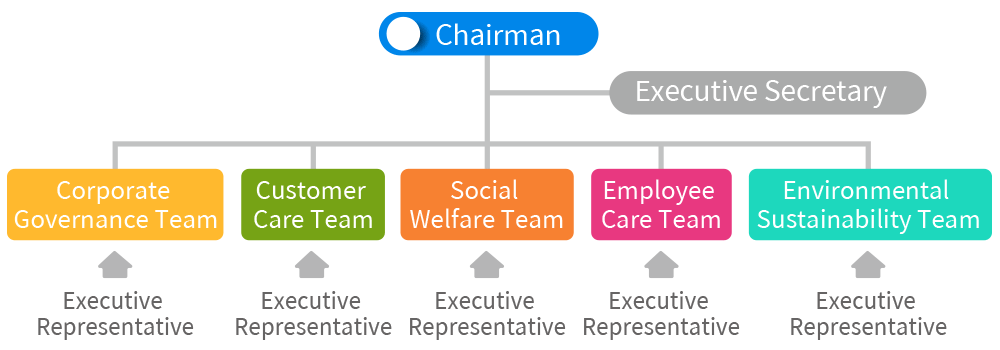
- The Administration Department is responsible for proposing and implementing the Company’s sustainability policies and related systems, and reports regularly to the Board of Directors. The Company has also established a Sustainability Task Force, which discusses key sustainability issues through internal meetings, reviews performance and future objectives, and promotes the Company’s management philosophy, environmental sustainability initiatives, and commitment to social responsibility.
- The Company reports annually to the Board of Directors on the implementation results of its sustainability initiatives and future action plans. In 2025, sustainability-related matters were reported to the Board on four occasions, covering topics including greenhouse gas inventory and verification planning, progress on sustainability initiatives, and the 2024 ESG Sustainability Report.
- Management submits the Company’s strategies to the Board of Directors for review. The Board assesses the likelihood of successful implementation, regularly monitors strategic progress, and, when necessary, requests management to make appropriate adjustments.